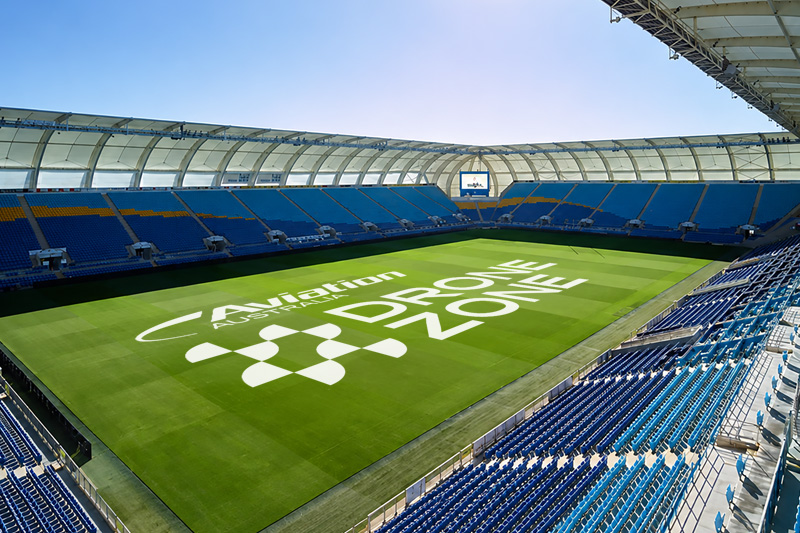
Global Drone® 2026 runs 11 – 13 November at CBUS Super Stadium, Robina, on the Gold Coast. The Drone Zone is the live demonstration arena on the CBUS playing field, and it is where the full spectrum of uncrewed systems comes off the page and into action. Across three days, 120 aerial, terrestrial, and aquatic drone demonstrations.
What Makes the Drone Zone Different
Most drone events stage demonstrations in a single domain. The Drone Zone operates across all three: aerial, terrestrial, and aquatic, alongside robotics, simultaneously, in real time, from a single venue. Delegates and the general public watch live from the stadium, with remote and off-site demonstrations including aquatic surveys and wildlife surveys beamed directly to the stadium’s big screens.
Exhibitors can incorporate live demonstrations into their expo and congress packages, meaning the systems on the field are not staged performances but active, working technology from the companies behind them.
Aerial Demonstrations
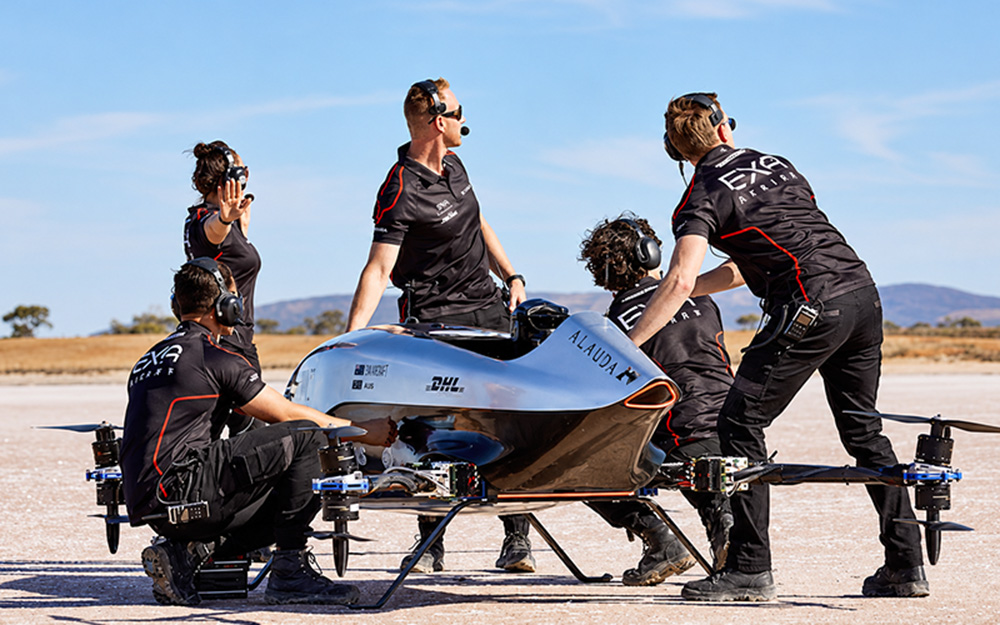
Live flights cover all levels and sizes of UAVs , staged on the CBUS playing field with big screens and grandstand seating. Demonstrations emphasise civilian technology innovation, from commercial drone manufacturers and drone service providers through to specialist infrared-capable drones conducting surveys of endangered wildlife and pest species.
Terrestrial Demonstrations
Ground-based robotic and autonomous systems are demonstrated on the playing field alongside aerial platforms. The Drone Zone is specifically designed to show civilian technology innovation across all drone domains, and terrestrial systems form a core part of that delivery.
Marine and Aquatic Demonstrations
Aquatic drone systems are demonstrated both on-site and remotely. Where demonstrations take place off-site, such as aquatic or wildlife surveys, the live feed is streamed directly to the big screens inside CBUS Stadium so delegates and the public see the systems operating in real time.
Wildlife Surveys in Real Time
Specialist infrared-capable drones conducting surveys of endangered wildlife are part of the programme. Remote survey operations are streamed live to the stadium screens, giving audiences direct sight of real-world applications as they happen.
The Congress Connection
The Drone Zone sits alongside six industry summits running concurrently at CBUS’s corporate facilities, including the Advanced Air Mobility Congress, Defence Robotics and Counter-UAS Summit, Agri-Business Drone Congress, and the Future Forecast and Innovation programme. Demonstrations in the Drone Zone directly support the congress content, with robotics and drone systems providing hands-on technical context for delegates.
The Scale of the Event
Global Drone® 2026 projects 200 exhibitors and 15,000 general attendees in Year 1. The event is positioned as the only event globally covering the full UAS spectrum: aerial, terrestrial, and aquatic, alongside robotics, with the aim of establishing the Gold Coast and South East Queensland as the APAC first-mover in the low-altitude economy ahead of the Brisbane 2032 Olympic and Paralympic Games.
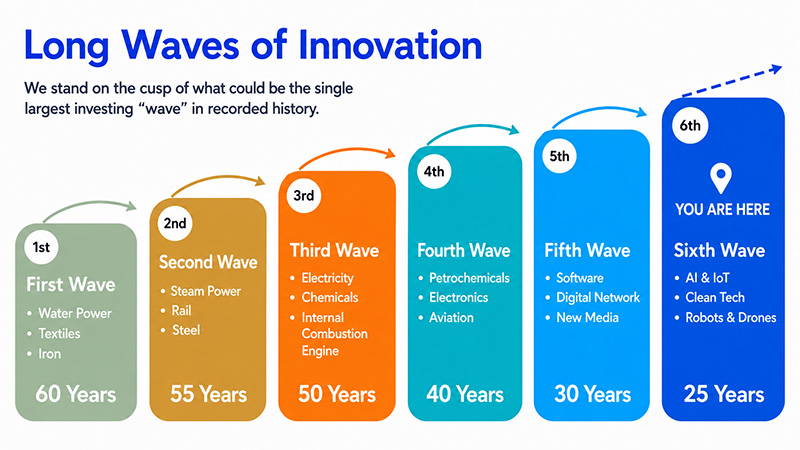
The history of these long-wave innovation cycles known Kondratiev waves follows these distinct, consecutive eras:. As one wave matures, it paves the way for the next reshaping global industries
- First Wave (1785–1845): Driven by the early Industrial Revolution, focusing on water power, textile manufacturing, and iron goods.
- Second Wave (1845–1900): Defined by steam power, steel production, and the massive expansion of railways.
- Third Wave (1900–1950): The era of electricity, basic chemicals, and internal combustion engines.
- Fourth Wave (1950–1990): Spurred by the aviation revolution, petrochemicals, and early electronics.
- Fifth Wave (1990–2020): Centered on information and communications technology (ICT), digital networks, and the internet.
- Sixth Wave (2020–Present): The ongoing transformation driven by artificial intelligence (AI), robotics, IoT, and clean technology. We are currently in this sixth wave of innovation, driven by artificial intelligence (AI), the Internet of Things (IoT), robotics, and clean tech. These technologies will redefine industries, improve efficiency, and address global challenges like climate change. The current is the biggest single investment